Budget ignores transport woes
Leader Newspapers
by Alex Munro
7 May 10
Friday, May 7, 2010


Thursday, May 6, 2010
the bandaid budget - weeds are taking over this state
Those volunteers who work tirelessly to improve our environment have good reason to disappointed with John Brumby’s bandaid budget.
Victoria has a crisis in transport, a crisis in water, a climate crisis, a housing crisis, a preventable disease crisis and a weed crisis. This budget treats the symptoms, but it ignores the causes of the crisis.
The budget contains insignificant amounts of funding to address the serious issue of invasive plants and animals.
“Weeds are overtaking our environment, they have a significant affect on water quality and quantity, contribute to extensive land degradation, impact heavily on habitat and biodiversity and create greater fire hazards”, said Samantha Dunn, Greens Upper House candidate for Eastern Victoria.
The amounts allocated to tackle weeds in high risk rural areas, for control programs in national parks and to outer suburban councils is paltry and just window dressing. “If the government is truly committed to tackling the weed crisis, then they need to provide appropriate levels of funding, this budget is a bandaid and a flimsy one at that”, said Samantha.
The Greens want to get to the root of our state’s weed problems and see effectively funded programs in place.
Hundreds of volunteers work tirelessly to rid our environment of weeds, but they need help, they need the resources to help them. Amongst many weed issues is that environmental weeds are not declared as noxious or regionally significant so local governments and community groups miss out on funding allocations through current state government programs targeted at noxious weeds.
However environmental weeds cause major problems in many of the interface regions of Melbourne. The problem is so great that the state needs to provide greater levels of support to community, to local government and to farmers trying to hold back what is fast becoming an explosive situation in Victoria.
“This budget has shown the government has little understanding of the problem and no commitment to truly tackle the weed crisis in Victoria.”
Victoria has a crisis in transport, a crisis in water, a climate crisis, a housing crisis, a preventable disease crisis and a weed crisis. This budget treats the symptoms, but it ignores the causes of the crisis.
The budget contains insignificant amounts of funding to address the serious issue of invasive plants and animals.
“Weeds are overtaking our environment, they have a significant affect on water quality and quantity, contribute to extensive land degradation, impact heavily on habitat and biodiversity and create greater fire hazards”, said Samantha Dunn, Greens Upper House candidate for Eastern Victoria.
The amounts allocated to tackle weeds in high risk rural areas, for control programs in national parks and to outer suburban councils is paltry and just window dressing. “If the government is truly committed to tackling the weed crisis, then they need to provide appropriate levels of funding, this budget is a bandaid and a flimsy one at that”, said Samantha.
The Greens want to get to the root of our state’s weed problems and see effectively funded programs in place.
Hundreds of volunteers work tirelessly to rid our environment of weeds, but they need help, they need the resources to help them. Amongst many weed issues is that environmental weeds are not declared as noxious or regionally significant so local governments and community groups miss out on funding allocations through current state government programs targeted at noxious weeds.
However environmental weeds cause major problems in many of the interface regions of Melbourne. The problem is so great that the state needs to provide greater levels of support to community, to local government and to farmers trying to hold back what is fast becoming an explosive situation in Victoria.
“This budget has shown the government has little understanding of the problem and no commitment to truly tackle the weed crisis in Victoria.”
Sunday, May 2, 2010
getting greener
Yesterday was an opportunity to fly the Greens flag at the Going Green expo at Jeff's Shed in Melbourne. Greens candidates were out in force to talk to people about all things Green.
One of the subjects that came up often was the Rudd Government's flawed and now shelved Carbon Pollution Reduction Scheme. People were curious to know why the Greens wouldn't support the emissions trading scheme, a scheme that would lock our country into a high polluting future, cost tax payers dearly and reward those who pollute the most.
Even more were curious to understand why the Rudd government won't negotiate with the Greens to establish a carbon levy.

Pictured left to right: Mark Riley – Greens Candidate for Wills, Samantha Dunn – Greens Candidate for Eastern Victoria and Colin Long – Greens Candidate for Eastern Metropolitan.
A recent Galaxy poll shows 72% of Australians want the government to negotiate with the Greens on a carbon levy. The Greens carbon levy, adapted from Professor Garnaut's proposal, is the best option to start some serious action on climate change.
The levy would ensure that the biggest polluters pay for climate pollution. We can't afford to delay action on climate change and the Greens have the way forward. It's time for the government to act in good faith on behalf of the people and negotiate with the Greens.
Saturday, May 1, 2010
sea shepherd finds some friends at sherbrooke
Last night I attended a fundraiser organised by Sherbrooke Community School student, Jordan Crooka to raise money for the Sea Shepherd. Jordan did a great job organising the food, entertainment and a myriad of auction items and raised over $3,000 for his efforts.
 Pictured left to right: Campbell Holland (Ships Engineer), Kate Henderwood, Jordan Crooka, Samantha Dunn and Sara Keltie (Marine Biologist).
The event was well supported by the local community and the crowd were treated to entertainment by Sherbrooke student Kate Henderwood accompanied by Jordan Crooka, Athula Mamaborupodakqua, The Ineligible and Anna Paddick (a very talented ex Sherbrooke student).
People were captivated by the presentation by Campbell Holland, Ships Engineer on the Sea Shepherd's ship the Bob Barker. Campbell gave a great insight to being a crew member on board a Sea Shepherd ship and the sorts of tactics the Japanese Whalers resort to in the Southern Ocean. This year's whaling season saw the Japanese whaler Shonan Maru 2 destroy the Sea Shepherd vessel Ady Gil. It was an atrocious act which endangered the lives of the six crew on board and highlighted the lack of scrutiny our government gives to what is happening out on the Southern Ocean.
Sara Keltie, Sea Shepherd Crew member and marine biologist gave an insight into the shocking trade in shark fin and the plight of critically endangered species such as Atlantic Bluefin Tuna and various species of Sharks (18 species are listed as endangered which is alarming given their status as alpha predators).

Sold! Enthusiastic auctioneers, Denise Dempsey, Robert Pergl and Jordan Crooka ran a pacey and energetic auction. It was terrific to see Greens Senator Bob Brown support the event by donating a signed photo taken by him of Recherche Bay in far South Tasmania (now happily hanging on my wall).
Well done Jordan, you are a credit to your school, motivated and passionate, our future looks bright with emerging leaders like you.
Friday, April 30, 2010
veac under threat
The Victorian Government has released plans to change conservation laws including abolishing the Victorian Environment Assessment Council (VEAC). Without VEAC future habitat protection in Victoria is at risk.
In the past VEAC and its predecessors have been instrumental in the creation of Victoria's National Parks and Reserves. VEAC has provided an independant, scientific evaluation of ecological values across Victoria and provided advice to government on what to protect.
The last thing our environment needs is to lose VEAC.
VNPA are asking people to gather signatures for their petition to support VEAC or sign their online petition.
VEAC have been instrumental in seeing these great places in Victoria protected:
Croajingalong National Park
Grampians National Park
Alpine National Park
Yarra Ranges National Park
Marine parks and sanctuaries covering 5.3% of coastal waters
Big Desert Wilderness & Avon Wilderness parks
Box Ironbark and Goldfields Heritage parks
Great Otway National Park
and most recently the River Red Gum National Parks
In the past VEAC and its predecessors have been instrumental in the creation of Victoria's National Parks and Reserves. VEAC has provided an independant, scientific evaluation of ecological values across Victoria and provided advice to government on what to protect.
The last thing our environment needs is to lose VEAC.
VNPA are asking people to gather signatures for their petition to support VEAC or sign their online petition.
VEAC have been instrumental in seeing these great places in Victoria protected:
Croajingalong National Park
Grampians National Park
Alpine National Park
Yarra Ranges National Park
Marine parks and sanctuaries covering 5.3% of coastal waters
Big Desert Wilderness & Avon Wilderness parks
Box Ironbark and Goldfields Heritage parks
Great Otway National Park
and most recently the River Red Gum National Parks
Thursday, April 29, 2010
food labelling – a consumer’s right to know
Today saw a public hearing in Melbourne for the National Food Labelling review. The review is being undertaken by The Food Labelling Law and Policy Review Committee following on from an agreement by the Council of Australian Governments (COAG) and the Australia and New Zealand Food Regulation Ministerial Council to undertake a comprehensive review of food labelling law and policy.
At the public hearing today around 50 people voiced their concerns about the lack of labelling in relation to country of origin, trans fats, food intolerances and genetically modified foods and ingredients. Consumers have a right to know what they're eating and at the moment Australia has very weak food labelling laws. 
Samantha Dunn, Greg Revell & Bob Phelps from GeneEthics and Jessica Harrison from Cropwatch with Eating in the Dark protesters. Consumers are eating in the dark, we all have a right to know exactly what is in our food.
I joined with Madge members and other concerned people outside the hearing at the Eating in the Dark Rally to raise awareness about the issue of food labelling to city passerby's.
For too long there have been exemptions to food labelling. No longer can we accept this proposition, all GM ingredients must be labelled on our foods. We have the right to know where processed food ingredients are made and what is in them, particularly new and untried processed foods.
The Committee has developed an issues paper from the first round of submissions which forms the basis of current public consultation. Some of the statements within the Issues Paper are concerning.
The issues paper which forms the basis of the public consultation falsely claims that GM foods are labelled, ignoring the current exemptions that allow most foods made with GM to be unlabelled such as GM vegetable oils, starches, sugars, processing aids & additives and also exempts meat, milk, honey and eggs from animals that are fed GM feed. There is also a 1% threshold for accidental GM contamination. All foods made using GM techniques must be labelled without exception. It is the consumers right to know and to select the food products they wish to consume using truthful, transparent and accurate food labelling information.
Other concerns with the issues paper includes the statement "caution needs to be exercised in order that the development and application of these and other innovative technologies (eg: GM, nanotechnology, irradiation) are not unduly inhibited". If foods contain GM ingredients, nanotechnology or are irradiated then consumers have a right to know and exercise their freedom of choice when purchasing these goods. These technologies should not be hidden in a shroud of secrecy, this is about consumer rights and choices.
Currently GM foods require Pre Market Clearance and must undergo health and safety assessments (not testing), however if they are not labelled they are not captured under this requirement.
GM patent owners still refuse to supply the seed and approvals for independent research and prevent negative evidence from being published. Until substantial and independent research is undertaken consumers cannot be assured of the safety of GM foods for the environment and public health. These are all reasons why our food labelling laws must be tightened up.
The Committee is calling for public submissions and this is your opportunity to voice your concerns about food labelling in this country. If you are concerned I encourage you to write an online submission, but make sure you're quick , they're due by 14th May, 2010.
Wednesday, April 28, 2010
Tuesday, April 20, 2010
Tuesday, April 13, 2010
Sunday, April 11, 2010
movie fundraiser – 6 may in belgrave
Support the Greens Eastern Victoria State Election Campaign, the Australian film industry and local independent cinema by coming along to the opening night of I Love You Too at the Cameo Cinema in Belgrave.
 Join Greens Upper House Candidate for Eastern Victoria Samantha Dunn to see I Love You Too. Bookings online.
I Love You Too is a romantic comedy about a commitment-phobic man-about-town and a gifted New Age dwarf who go on a quest to win the women they love. Written by comedian Peter Helliar, from the producers of Summer Heights High and filmed in Melbourne, 'I Love You Too' is a story about the meaning of relationships, the importance of male friendship and having the courage to pursue the one you love. I Love You Too stars Peter Helliar, Brendan Cowell, Megan Gale, Yvonne Strahovski and US actor Peter Dinklage.
I Love You Too is a great opportunity to support local filmmaking, the Greens election campaign and have a bit of a laugh too.
Bookings online
When: Thursday 6th May
What: nibbles and drinks at 8pm, movie at 8:30pm
Where: Cameo Cinema, 1628 Burwood Highway, Belgrave
Cost: $15 per person
Donations: gratefully accepted
Donations of up to $1500 per financial year to a political party are tax deductible
Or for more info email samantha.dunn@vic.greens.org.au
Saturday, April 10, 2010
no flow for snowy
I recently toured East Gippsland and found myself in Marlo where the Snowy River meets the sea. A wonderful part of Victoria, the place bursting with recreational anglers, kayakers and bushwalkers, enjoying the great natural environment.
But underlying this beautiful slice of Victoria was the sad and sorry state of the Snowy River. It was alarming to see the state of the river, degraded, with obvious signs of strain and lack of water flow. The silting, apparent, above the water line, was a tragic sight of how this mighty river is suffering under years of lack of natural water flows.

It is a tragedy to see this iconic Australian river in such a degraded state. If there is any hope of saving the Snowy and restoring it to a much healthier state there must be environmental flows of 28%, to do anything less is failing our heritage and our future.
As far back as 1996 the Expert Panel Flow Assessment of the Snowy River Below Jindabyne recommended a 28% mean annual natural flow needed to maintain a healthy Snowy River.
The current Labor government under Steve Brack’s leadership promised they would restore 28% flow to the Snowy. That all changed when the Snowy Hydro was corporatised in 2002, however legislation committed to funding the restoration of 21% of annual natural flow to the Snowy below the Jindabyne Dam.
The legislated environmental flow targets for the Snowy River indicate by 2009 the return of 15% flows, by 2012 the return of 21% flows and after 2012 the return of 28% of environmental flows in line with the advice of the Expert Panel back in 1996.
The reality of the water flow in the Snowy is a stark difference to the legislated flows and paints a picture of a river under extreme duress. Actual Snowy River Environmental flows are shocking, in 2002/03 the environmental flows were 1.7%,
2003/04 3.3%, 2004/05 2.8%,
2005/06 4.3%, 2006/07 3.9%,
2007/08 3.5%, 2008/09 4.04%
and for this year (2009/10) planned releases of 4.01%.
A long way from the legislated 15% and nowhere near the 28% the Snowy needs to recover.
But underlying this beautiful slice of Victoria was the sad and sorry state of the Snowy River. It was alarming to see the state of the river, degraded, with obvious signs of strain and lack of water flow. The silting, apparent, above the water line, was a tragic sight of how this mighty river is suffering under years of lack of natural water flows.

It is a tragedy to see this iconic Australian river in such a degraded state. If there is any hope of saving the Snowy and restoring it to a much healthier state there must be environmental flows of 28%, to do anything less is failing our heritage and our future.
As far back as 1996 the Expert Panel Flow Assessment of the Snowy River Below Jindabyne recommended a 28% mean annual natural flow needed to maintain a healthy Snowy River.
The current Labor government under Steve Brack’s leadership promised they would restore 28% flow to the Snowy. That all changed when the Snowy Hydro was corporatised in 2002, however legislation committed to funding the restoration of 21% of annual natural flow to the Snowy below the Jindabyne Dam.
The legislated environmental flow targets for the Snowy River indicate by 2009 the return of 15% flows, by 2012 the return of 21% flows and after 2012 the return of 28% of environmental flows in line with the advice of the Expert Panel back in 1996.
The reality of the water flow in the Snowy is a stark difference to the legislated flows and paints a picture of a river under extreme duress. Actual Snowy River Environmental flows are shocking, in 2002/03 the environmental flows were 1.7%,
2003/04 3.3%, 2004/05 2.8%,
2005/06 4.3%, 2006/07 3.9%,
2007/08 3.5%, 2008/09 4.04%
and for this year (2009/10) planned releases of 4.01%.
A long way from the legislated 15% and nowhere near the 28% the Snowy needs to recover.
Wednesday, April 7, 2010
Thursday, April 1, 2010
coal conference closes door on community
Earlier this week the Australian Journal of Mining hosted the Victorian Coal and Energy Conference in Traralgon. At a price tag of around $3,000 per delegate it was clear that this conference wasn’t open to community members.
Local community members weren’t invited, the union wasn’t invited and local environment groups weren’t invited either. And even if they were invited at that sort of cost, who could afford it?
We know that brown coal contributes significantly to greenhouse gas emissions and is responsible for around half of Victoria’s total emissions. Was this conference about the expansion of brown coal exports? It doesn’t matter where brown coal is burnt for power generation, it pollutes the world’s atmosphere and is a significant contributor to greenhouse gas emissions no matter where it is.
Government should be focussing on a sustainable transformation of the energy sector and revitalizing the valley for a brighter more sustainable future.
It is a slap in the face to the local families and workers who have a right to participate in determining their future in the valley.
Local community members weren’t invited, the union wasn’t invited and local environment groups weren’t invited either. And even if they were invited at that sort of cost, who could afford it?
We know that brown coal contributes significantly to greenhouse gas emissions and is responsible for around half of Victoria’s total emissions. Was this conference about the expansion of brown coal exports? It doesn’t matter where brown coal is burnt for power generation, it pollutes the world’s atmosphere and is a significant contributor to greenhouse gas emissions no matter where it is.
Government should be focussing on a sustainable transformation of the energy sector and revitalizing the valley for a brighter more sustainable future.
It is a slap in the face to the local families and workers who have a right to participate in determining their future in the valley.
Monday, March 22, 2010
duck hunting - time to say no
Over the weekend saw the opening of Duck Hunting season in Victoria. Given the population of wild ducks in country Victoria and the ongoing drought it is difficult to fathom that the Brumby government has allowed another duck hunting season to continue.
The governments of the ACT, NSW, QLD and WA have seen fit to make it illegal to hunt ducks for sport, but the Brumby government lags well behind.
A Roy Morgan poll conducted in 2007 indicated that 87% of Victorians support a ban on duck hunting.
Research has shown for every 10 ducks bagged, 6 are crippled. Many of the birds are left to suffer a terrible prolonged death as shooters injure the birds.
The impact of the drought over the last 13 years has had a severe impact on Victoria’s wetlands and consequently on the habitat available to sustain duck populations. Although there has been a slight increase in bird numbers this year, research shows an overall decline of 82% in the population of water birds since 1982.
With climate change we won’t see a recovery of the wetlands which makes me question how the Brumby government can justify the continuation of this practice.
Duck hunting is inhumane and cruel practice and fortunately there are very few registered hunters.
It is time for the Brumby government to join with the other states and ban this outmoded and cruel practice.
The governments of the ACT, NSW, QLD and WA have seen fit to make it illegal to hunt ducks for sport, but the Brumby government lags well behind.
A Roy Morgan poll conducted in 2007 indicated that 87% of Victorians support a ban on duck hunting.
Research has shown for every 10 ducks bagged, 6 are crippled. Many of the birds are left to suffer a terrible prolonged death as shooters injure the birds.
The impact of the drought over the last 13 years has had a severe impact on Victoria’s wetlands and consequently on the habitat available to sustain duck populations. Although there has been a slight increase in bird numbers this year, research shows an overall decline of 82% in the population of water birds since 1982.
With climate change we won’t see a recovery of the wetlands which makes me question how the Brumby government can justify the continuation of this practice.
Duck hunting is inhumane and cruel practice and fortunately there are very few registered hunters.
It is time for the Brumby government to join with the other states and ban this outmoded and cruel practice.
Tuesday, March 16, 2010
in the press - public transport
Commuters Say Ringwood Railway Station Hard to Access and Dirty
Maroondah Leader
by Shaun Campbell
16 Mar 2010
Maroondah Leader
by Shaun Campbell
16 Mar 2010
Monday, March 15, 2010
Monday, March 1, 2010
Sunday, February 28, 2010
reflex action launched
Over the weekend I spoke at the Kick Reflex out campaign launch at the Maryvale Paper Mill.

Robbie Thorpe, from the Krautungalung people of the Gunnai Nation did the welcome to country.
"We know that Victoria is the most cleared state in Australia with less than 30% of our original bushland remaining on public land and less than 8% on private land.
We know about the link between forests, water supply and water quality. Because of logging in water catchments we have lost billions and billions of litres of water, the ongoing logging of water catchments continues to put our water supply at risk.

Greens Senator, Scott Ludlam and Samantha Dunn, Greens Candidate for Eastern Victoria at the Maryvale Pulp Mill.
We know that the Mountain Ash forests found in Eastern Victoria have the greatest carbon carrying capacity of any forest in the world and have a significant role to play in addressing climate change.
We know that the continued logging of wet forests makes them more fire prone.
We know that the ongoing clearance of vegetation contributes significant amount greenhouse gas emissions.
And we know that logging our forests has significant impacts on biodiversity with endangered species on the brink of extinction including our own state faunal emblem, the Leadbeater's Possum.
In spite of all this knowledge our government continues to condone the logging of our native forests. The tragedy of it is that around 70%, 7 in 10 logs, are pulped for paper and when my community (Yarra Ranges) sees those logging trucks rumbling through their towns they see a wasted opportunity for a more sustainable timber industry and a more sustainable future.

We must have a new vision for timber and that is with plantation timber. It is possible to transition and with that transition we must look after the forestry workers.
Currently forestry workers are losing their jobs. But it's not through any conservation efforts, it's due to the increased mechanisation of the industry, consumer preference for pine and increased wood chipping.
The Greens are committed to supporting workers through the industry transition to a new sustainable future.

Are woodchips from our native forests the only way to make paper? No of course they're not. Existing plantations are the way forward, there will need to be transport infrastructure upgrades from Western Victoria to deliver plantation timber (to Maryvale) and government has a role to play in seeing this happen.
Did you know it is not possible to purchase Australian made paper that is 100% recyclable post consumer waste? This is a travesty that consumers wanting to do the right thing are forced to purchase this product from the US or Europe. It a market gap crying out to be filled by an Australian paper maker.
A transition of the timber and paper products industry will see protection of our water supply catchments and will start to redress the loss of precious biodiversity which provides us with ecological services. It will also assist in addressing climate change.
It is possible to have a vibrant economy in thriving regional communities with increased employment opportunities but pulping our forests is not the way.
Is it a good use of our forests? No.
What are you going to do about it?
Who are you going to tell about today's event?
What brand of paper are you going to buy?
It is a scandal to see our native forests pulped, it is time to stop, it is no longer acceptable.
It is time to get out of forests and into plantations."

Robbie Thorpe, from the Krautungalung people of the Gunnai Nation did the welcome to country.
"We know that Victoria is the most cleared state in Australia with less than 30% of our original bushland remaining on public land and less than 8% on private land.
We know about the link between forests, water supply and water quality. Because of logging in water catchments we have lost billions and billions of litres of water, the ongoing logging of water catchments continues to put our water supply at risk.

Greens Senator, Scott Ludlam and Samantha Dunn, Greens Candidate for Eastern Victoria at the Maryvale Pulp Mill.
We know that the Mountain Ash forests found in Eastern Victoria have the greatest carbon carrying capacity of any forest in the world and have a significant role to play in addressing climate change.
We know that the continued logging of wet forests makes them more fire prone.
We know that the ongoing clearance of vegetation contributes significant amount greenhouse gas emissions.
And we know that logging our forests has significant impacts on biodiversity with endangered species on the brink of extinction including our own state faunal emblem, the Leadbeater's Possum.
In spite of all this knowledge our government continues to condone the logging of our native forests. The tragedy of it is that around 70%, 7 in 10 logs, are pulped for paper and when my community (Yarra Ranges) sees those logging trucks rumbling through their towns they see a wasted opportunity for a more sustainable timber industry and a more sustainable future.

We must have a new vision for timber and that is with plantation timber. It is possible to transition and with that transition we must look after the forestry workers.
Currently forestry workers are losing their jobs. But it's not through any conservation efforts, it's due to the increased mechanisation of the industry, consumer preference for pine and increased wood chipping.
The Greens are committed to supporting workers through the industry transition to a new sustainable future.

Are woodchips from our native forests the only way to make paper? No of course they're not. Existing plantations are the way forward, there will need to be transport infrastructure upgrades from Western Victoria to deliver plantation timber (to Maryvale) and government has a role to play in seeing this happen.
Did you know it is not possible to purchase Australian made paper that is 100% recyclable post consumer waste? This is a travesty that consumers wanting to do the right thing are forced to purchase this product from the US or Europe. It a market gap crying out to be filled by an Australian paper maker.
A transition of the timber and paper products industry will see protection of our water supply catchments and will start to redress the loss of precious biodiversity which provides us with ecological services. It will also assist in addressing climate change.
It is possible to have a vibrant economy in thriving regional communities with increased employment opportunities but pulping our forests is not the way.
Is it a good use of our forests? No.
What are you going to do about it?
Who are you going to tell about today's event?
What brand of paper are you going to buy?
It is a scandal to see our native forests pulped, it is time to stop, it is no longer acceptable.
It is time to get out of forests and into plantations."
Thursday, February 25, 2010
save the bush – melbourne’s last intact remnant bush going, going…..gone
Yesterday I went to the Save the Bush rally on the steps of Parliament to hear community groups speaking out about the construction of Peninsula Link and the destruction of some of Melbourne’s last remnant bush.

The Greens were proud to support the event and have a long history of campaigning for improved public transport and protection of remnant vegetation.
From left to right: Sue Pennicuik - Greens MLC for Southern Metropolitan Region, Brian Walters - Greens candidate for Melbourne, Colleen Hartland - Greens MLC for Western Metropolitan Region, Samantha Dunn - Greens candidate for Eastern Victoria Region and Colin Long - Greens candidate for South Eastern Metropolitan Region.
The event, a joint action between Save The Pines, SOBA (Save our Bushland Alliance), Friends of Banyule, Green Wedge Coalition, Protector of Public Lands and the Greens. Rod Quantock MC’d the event, a funeral for the death of biodiversity in Melbourne.
The speakers talked about the loss of biodiversity, particularly tragic in this International Year of Biodiversity. The loss of amenity, destruction of heritage sites, the lack of focus on public transport upgrades and over reliance on motor vehicles were also key issues raised against the construction of the road.
Rather than some minor local road upgrades, the government has chosen and expensive and unsustainable transport solution for the people of the peninsula.
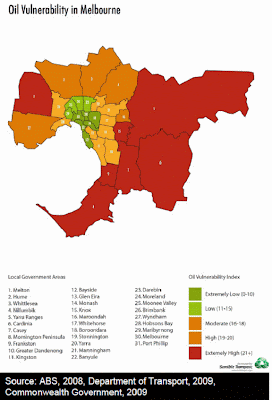 This map shows how vulnerable each municipality in greater Melbourne are to rising oil prices. It is no coincidence that those suburbs with poor public transport options and a reliance on motor vehicles to get around are very vulnerable. Unless there are significant upgrades to public transport these areas will become severely transport disadvantaged in the future.
Once again the people of the Mornington Peninsula are relegated to their cars to rely on as their main mode of transport. A recent projection by the CSIRO showed that Mornington Peninsula was the second highest most vulnerable metropolitan municipality when oil prices rise due to peak oil. The projections showed that people of Mornington Peninsula will be spending a greater proportion of their income on fuel in comparison to those living in inner city suburbs with a good public transport network. Just for the record Cardinia was the most vulnerable municipality whilst Yarra Ranges came in fourth highest.
 Save the Bush included a mock funeral to mark the death of Melbourne's intact remnant vegetation.
Residents are keen to see local road upgrades and improvements in public transport as a way to address congestion issues, far more sensible long term solutions. Building roads does not relieve congestion, it only adds to congestion, anyone who’s driven on Melbourne’s freeways over the last decade would realise that.
Congestion costs Victoria an estimated $1.3 to $2.6 billion per annum (VCEC inquiry into Road Congestion 2007/08). The freeway will cut through many reserves in the region including the Pines Flora & Fauna Reserve, Carrum Downs wetlands, Pobblebonk Wetland Reserve, Wittenberg Reserve, Belvedere Reserve & woodlands and the Westerfields Heritage Woodlands.
It is tragic to think that Melbourne’s last intact remnant bush at the Pines Flora & Fauna Reserve will be decimated by the construction of Peninsula Link. A precious piece of bush providing habitat for the endangered Southern Brown Bandicoot amongst many other endangered species.
If the government were genuine about real action on climate change and any action on peak oil, providing real solutions for Melbourne wouldn’t consist on a network of freeways for our city. We don’t need more freeways, we need sustainable transport options.

The Greens were proud to support the event and have a long history of campaigning for improved public transport and protection of remnant vegetation.
From left to right: Sue Pennicuik - Greens MLC for Southern Metropolitan Region, Brian Walters - Greens candidate for Melbourne, Colleen Hartland - Greens MLC for Western Metropolitan Region, Samantha Dunn - Greens candidate for Eastern Victoria Region and Colin Long - Greens candidate for South Eastern Metropolitan Region.
The event, a joint action between Save The Pines, SOBA (Save our Bushland Alliance), Friends of Banyule, Green Wedge Coalition, Protector of Public Lands and the Greens. Rod Quantock MC’d the event, a funeral for the death of biodiversity in Melbourne.
The speakers talked about the loss of biodiversity, particularly tragic in this International Year of Biodiversity. The loss of amenity, destruction of heritage sites, the lack of focus on public transport upgrades and over reliance on motor vehicles were also key issues raised against the construction of the road.
Rather than some minor local road upgrades, the government has chosen and expensive and unsustainable transport solution for the people of the peninsula.
 This map shows how vulnerable each municipality in greater Melbourne are to rising oil prices. It is no coincidence that those suburbs with poor public transport options and a reliance on motor vehicles to get around are very vulnerable. Unless there are significant upgrades to public transport these areas will become severely transport disadvantaged in the future.
 Once again the people of the Mornington Peninsula are relegated to their cars to rely on as their main mode of transport. A recent projection by the CSIRO showed that Mornington Peninsula was the second highest most vulnerable metropolitan municipality when oil prices rise due to peak oil. The projections showed that people of Mornington Peninsula will be spending a greater proportion of their income on fuel in comparison to those living in inner city suburbs with a good public transport network. Just for the record Cardinia was the most vulnerable municipality whilst Yarra Ranges came in fourth highest.
 Save the Bush included a mock funeral to mark the death of Melbourne's intact remnant vegetation.
Residents are keen to see local road upgrades and improvements in public transport as a way to address congestion issues, far more sensible long term solutions. Building roads does not relieve congestion, it only adds to congestion, anyone who’s driven on Melbourne’s freeways over the last decade would realise that.
Congestion costs Victoria an estimated $1.3 to $2.6 billion per annum (VCEC inquiry into Road Congestion 2007/08). The freeway will cut through many reserves in the region including the Pines Flora & Fauna Reserve, Carrum Downs wetlands, Pobblebonk Wetland Reserve, Wittenberg Reserve, Belvedere Reserve & woodlands and the Westerfields Heritage Woodlands.
It is tragic to think that Melbourne’s last intact remnant bush at the Pines Flora & Fauna Reserve will be decimated by the construction of Peninsula Link. A precious piece of bush providing habitat for the endangered Southern Brown Bandicoot amongst many other endangered species.
If the government were genuine about real action on climate change and any action on peak oil, providing real solutions for Melbourne wouldn’t consist on a network of freeways for our city. We don’t need more freeways, we need sustainable transport options.
Wednesday, February 24, 2010
Tuesday, February 23, 2010
Monday, February 22, 2010
logging for pulp – our forests in jeopardy
On Saturday 26th February I will be joining Senator Scott Ludlam at the Kick Reflex out of our Forests campaign at the Maryvale Mill in Gippsland.

Organised by Friends of the Earth, I will be speaking on water catchments and local communities, while Senator Scott Ludlam will talk about the history of the successful WA consumer campaign Buy-pass Bunnings.
We will be joined by speakers talking about sustainable paper alternatives, logging in the Strzezleckis and the day will start with a welcome to country by Robbie Thorpe.
The majority of trees logged in Melbourne's water catchments are chipped and end up at the Maryvale mill where they are made into Reflex Paper and other single-use paper products.
It is time to see our water catchments and high conservation value forests protected from woodchipping, and a switch to an Australian wholly-recycled and plantation-based paper industry.
If you'd like more information on the event click here.
Wednesday, February 17, 2010
safer roads means safer communities
For many years now, I have campaigned to get speed limits through our townships lowered to 50kph.
To read on visit Cr Samantha Dunn.
in the press
Red tape a killer
Mail Newspapers
By Tania Martin
16th Feb 2010
To read on visit Cr Samantha Dunn.
in the press
Red tape a killer
Mail Newspapers
By Tania Martin
16th Feb 2010
in the press - planning
Planning laws raise objection
Councillor Samantha Dunn fears the changes will lead to a loss of local input into planning decisions
Mail Newspapers
By Tania Martin
16th Feb 2010
Councillor Samantha Dunn fears the changes will lead to a loss of local input into planning decisions
Mail Newspapers
By Tania Martin
16th Feb 2010
Monday, February 15, 2010
time to restore a safe climate
Yesterday I attended the launch of the Transition Decade, a collaboration between Friends of the Earth, The Climate Emergency Network, Beyond Zero Emissions, Sustainable Living Foundation, Australian Youth Climate Coalition, Environment Victoria, and many others.
 Samantha Dunn and Richard Di Natale, Greens Senate Candidate for Victoria, at the launch of the Transition Decade at the Melbourne Town Hall.
The Transition Decade seeks to mobilise community collaboration and action to see cuts in carbon emissions at a state, national and local level. This comes after we have seen failure at all levels to deliver even small cuts in carbon emissions and the failure of Copenhagen negotiations to produce any meaningful outcome.
Climate Scientists tell us that the time to act is now, we only have the smallest of windows to restore a safe climate.
We have the knowledge, the technology and the capacity to restore a safe climate, but there is very little political will to take real action on climate change.
Victoria is well positioned to capitalise on new jobs, skills, technologies and markets in a low carbon economy.
There will be regions of Victoria which are vulnerable to a carbon tax or emissions trading scheme, where businesses and community will need support for the transition to a low carbon economy. I am committed to seeing their needs supported as these communities transition to a new economy.
Political will is a key driver to change to restore a safe climate, time and time again many speakers spoke to this at the launch of the Transition Decade.
There is no time to waste, it’s time to act now before it’s too late, we all have a part to play to restore a safe climate.
Samantha Dunn and Richard Di Natale, Greens Senate Candidate for Victoria, at the launch of the Transition Decade at the Melbourne Town Hall.The Transition Decade seeks to mobilise community collaboration and action to see cuts in carbon emissions at a state, national and local level. This comes after we have seen failure at all levels to deliver even small cuts in carbon emissions and the failure of Copenhagen negotiations to produce any meaningful outcome.
Climate Scientists tell us that the time to act is now, we only have the smallest of windows to restore a safe climate.
We have the knowledge, the technology and the capacity to restore a safe climate, but there is very little political will to take real action on climate change.
Victoria is well positioned to capitalise on new jobs, skills, technologies and markets in a low carbon economy.
There will be regions of Victoria which are vulnerable to a carbon tax or emissions trading scheme, where businesses and community will need support for the transition to a low carbon economy. I am committed to seeing their needs supported as these communities transition to a new economy.
Political will is a key driver to change to restore a safe climate, time and time again many speakers spoke to this at the launch of the Transition Decade.
There is no time to waste, it’s time to act now before it’s too late, we all have a part to play to restore a safe climate.
Sunday, February 7, 2010
one year on
The 7th February, 2010, one year on from Black Saturday, is a day of contemplation and a day of remembrance. Thoughts turn to those terrible events one year ago, the tragic loss of life, the devastating loss of people’s homes and the shocking loss of wildlife and bushland.
In Yarra Ranges, where I'm a shire councillor, the fires continued to burn for weeks after Black Saturday. Our community either traumatised by the fire that had been or in fear of the fire that threatened.
The tireless efforts of the CFA volunteers were heroic, there were amazing gestures of generosity from near and far as people responded to the tragedy that was unfolding before us.
One year on, we see recovery, rebuilding and regeneration. People starting the journey to get their lives back on track, new houses being built and the bush regenerating.
Our natural environment provides a backdrop message of hope to our fire affected communities. Gum trees covered in epicormic growth, species of plants only ever seen after bushfire, mass displays of spring flowers, blackened tree ferns with their lime green fronds, all in response to fire.
It will take a long time to recover from such a calamitous natural disaster, Black Saturday has affected many people in many ways. With understanding and care people will rebuild their lives, overcome the trauma and learn to live with the memories.
At this one year mark, my thanks again to all the volunteers who went well beyond the call of duty in responding to Black Saturday and still do to this day.
I also extend my heartfelt and sincere well wishes to all those people who lost loved ones in the fires, this day will be difficult for you but know that our thoughts are with you.
In Yarra Ranges, where I'm a shire councillor, the fires continued to burn for weeks after Black Saturday. Our community either traumatised by the fire that had been or in fear of the fire that threatened.
The tireless efforts of the CFA volunteers were heroic, there were amazing gestures of generosity from near and far as people responded to the tragedy that was unfolding before us.
One year on, we see recovery, rebuilding and regeneration. People starting the journey to get their lives back on track, new houses being built and the bush regenerating.
Our natural environment provides a backdrop message of hope to our fire affected communities. Gum trees covered in epicormic growth, species of plants only ever seen after bushfire, mass displays of spring flowers, blackened tree ferns with their lime green fronds, all in response to fire.
It will take a long time to recover from such a calamitous natural disaster, Black Saturday has affected many people in many ways. With understanding and care people will rebuild their lives, overcome the trauma and learn to live with the memories.
At this one year mark, my thanks again to all the volunteers who went well beyond the call of duty in responding to Black Saturday and still do to this day.
I also extend my heartfelt and sincere well wishes to all those people who lost loved ones in the fires, this day will be difficult for you but know that our thoughts are with you.
Subscribe to:
Posts (Atom)



 Posts
Posts


