Showing posts with label logging. Show all posts

Saturday, October 23, 2010

it's got to stop joe

Earlier this week I joined with community members outside the offices of Joe Helper, Minister for Agriculture and in charge of VicForests, to protest to the ongoing logging in the Central Highlands, I was there representing the Shire of Yarra Ranges (I am a councillor there).

The Shire of Yarra Ranges council is opposed to the logging of Melbourne's water catchments and is also opposed to logging where it has significant effects on the local economy, tourism features and the environment. Thanks to Brent Lukey for the image.
.
.
.
.
.
.
.
.
The protest was to highlight the ongoing destruction caused by logging burnt and green forests in the Central Highlands, an already fragile environment due to the Black Saturday fires.

Much wood has been logged after the fires, causing untold damage to the forest. Local residents angry about the constant stream of logging trucks on roads, angry about logging on prominent ridgelines in tourist towns and angry that the forests haven't been given a chance to regenerate naturally.

Thanks to Brent Lukey for this image.

Logging has also occurred in the Armstrong Catchment, one of Melbourne's closed water catchments, contrary to the advice given in the BAER report (a report from experts about how to best to deal with environmental impacts post fire).

Huw Slater, Greens candidate for Seymour, was there too.

The BAER report urged conservation action for a number of endangered species at risk, warned against salvage logging and also stated that no more than 236 hectares of burnt forest should be salvage logged. Contrary to this advice the government allowed more than 10 times this amount of forest to be logged setting our endangered species on a short trail to extinction.

The Greens want to see an end to industrial scale logging of our native forests. The role the forests play in securing water, storing carbon and maintaining a healthy biodiversity is far more critical than logging the forests for woodchips.

It was good to see today that the CFMEU agrees that there needs to be transition out of native forests and in to plantations. Plantation timbers can supply our timber needs and the Greens support a proper transition to assist those workers, their families and communities to move from native forest logging to plantation timber.

Saturday, July 17, 2010

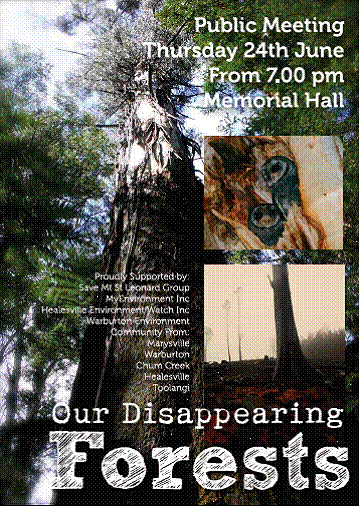
our disappearing forests community forum in Warburton

OUR DISAPPEARING FORESTS . . .

WHY SAVING OUR FORESTS MEANS SECURING OUR FUTURE


A Community Forum with guest speakers and presenters,

sponsored by Warburton Environment


When: SATURDAY 24TH JULY, 1PM-4PM


Where: MECHANICS HALL, UPPER YARRA ARTS CENTRE, WARBURTON


This forum is an opportunity for our local community to hear and be informed about what is happening and being planned for logging in our Central Highlands native forests from a range of perspectives, and what are the consequences for our community, our environment and our future industries.


Invited speakers include representatives from environmental groups, The Shire of Yarra Ranges, all major political parties and forest industry representatives.


Confirmed presenters include Steve Meacher (MC- Chairman Healesville Environment Watch), Christian Nielsen (Warburton Environment), Sarah Rees and Adam Menary (My Environment,) Samantha Dunn (Shire of Yarra Ranges, The Greens), Bernie Mace (Friends of Mt St Leonard) and Chris Taylor (architect).


Questions to be addressed include "should our native forests be logged for wood chips" and "what are the consequences of clear fell logging in the Central Highlands forests and Melbourne's water catchments?" How does this contribute to climate change, species extinction, carbon reduction and water conservation? What is the future for local industries, including tourism, logging and sustainable businesses?


For more info email warburtonenvironment@bigpond.com

Friday, June 25, 2010

time for permanent fix for forests crisis

Public, industry, politics agree:

Time for permanent fix for forests crisis

Senator Bob Brown

With the collapse of overseas woodchip markets and the growth of plantation forests, results of a new national poll show unprecedented support for ending logging in Australian native forests.


Launching a new television advertisement calling for an end to native forest logging, Australian Greens Leader Bob Brown said there had never been a more opportune time for the Commonwealth Government to step in and end conflict over forests forever.


The results of a national Galaxy research poll of 1,100 people show:

* 90% of Australians are in favour of protecting remaining high conservation value forests in Tasmania, Victoria and New South Wales in national parks.

* 77% agree that the Rudd Government should stop the logging of native forests, which contain large amounts of carbon that would be protected by ending forest clearance

* 72% are in favour of the Federal Government assisting logging contractors to take redundancies, retrain or move permanently to a plantation based industry


"The logging industry is now asking for help to assist workers and companies to shift from unsustainable native forest logging to plantation based forestry," said Senator Brown.


"The Commonwealth Government should step in.


"Having turned its back on putting a price on greenhouse pollution this is the easiest, simplest way for the Rudd Government to be able to say it has reduced Australia's greenhouse emissions.


"There is overwhelming public support for the creation of new national parks to protect our precious remaining forests.


"There is no future in native forest logging. Plantation timber is the preference of the global market, and now dinosaur companies like Gunns are in trouble, it is time to end Australian native forest logging forever."


A meeting of representatives from Australian environment groups convened by Senator Brown last week endorsed the idea that native forest logging should end and that Australia should utilise its existing plantation base for forest products.

Wednesday, June 23, 2010

Monday, May 24, 2010

logging costs us billions of litres

Over the last weekend I toured the Central Highlands with a group of concerned citizens from across Melbourne. The tour took us to logging coupes as well as pristine areas of wet forest across the Central Highlands region.

Cement Creek is a forest with considerable tracts of high conservation old growth forest, precious for its lead beaters possum habitat, it includes a site of aboriginal significance and not to mention its value as a carbon store. It is part of Melbourne’s Water Catchment.

The Cement Creek Water Catchment remains intact, but for how long? Back in 2008 Cement Creek received a reprieve from scheduled logging, however there is no long term guarantee that this pristine and important part of Melbourne’s water supply will not be logged in the future.

It is a travesty that our water catchments continue to be logged, back in 1999 the opposition (now the current Government) promised to cease logging in Melbourne’s water catchments, but we’ve seen no commitment to fulfil this promise. In fact the agency who manages our forests, Vic Forests, wants an additional 148 logging coupes across the Powelltown, Toolangi and Marysville regions.


This logging coupe is in the Starvation Creek region. Industrial logging of our wet forests is changing the make up of the forest, turning them into drier, more fire prone forests.

Logging has a detrimental impact on the water quantity and quality in our water catchments. We have already lost billions and billions of litres of water supply from past woodchipping. We have a government that has spent $1 billion on a pipeline with questionable water supply and $4.8 billion on a desalination plant which will cause untold environmental damage.


This “habitat” tree has been left to provide a home for native animals. It is stranded in a desolate landscape with no connectivity to any other trees or undestorey at all. The coupe's ‘regeneration’ burn has damaged the tree’s inner core. This will ultimately kill the tree, which spans 16 metres at the base.


If our government stopped logging all our catchments tomorrow we would gain 18 gigalitres of water a year, that’s 18 billion litres of water returned to Melburnians every year.Post 2009 bushfires, the forest in the burnt areas of our water catchments is in a far more fragile state.


The forest near Marysville is undergoing regeneration, if left, fire affected forests will regenerate and once again be a place that flourishes. Salvage logging these regions will see them destroyed forever with no chance to truly regenerate back to a wet forest.

The best thing for Melbourne’s water supplies, fauna and flora would be to let the forest naturally regenerate however salvage logging is going on at an alarming rate in our water catchments right now (see blog).

A logging coupe just off the Acheron Way. Logging is undertaken back from the road so tourists travelling through the region see a tract of native forest, however look beyond this buffer and you will see countless logging coupes. Victoria’s Mountain Ash forests are the most carbon dense in the world, worth protecting, not worth woodchipping.

Victoria is in a fortunate position, we don’t have to log our forests. Victoria has Australia’s largest plantation estate and it’s finally reaching maturity. Our plantations have enough timber to supply all our woodchipping needs allowing us to protect our precious water supplies and retain timber industry jobs.

Sunday, February 28, 2010

reflex action launched

Over the weekend I spoke at the Kick Reflex out campaign launch at the Maryvale Paper Mill.


Robbie Thorpe, from the Krautungalung people of the Gunnai Nation did the welcome to country.

"We know that Victoria is the most cleared state in Australia with less than 30% of our original bushland remaining on public land and less than 8% on private land.

We know about the link between forests, water supply and water quality. Because of logging in water catchments we have lost billions and billions of litres of water, the ongoing logging of water catchments continues to put our water supply at risk.


Greens Senator, Scott Ludlam and Samantha Dunn, Greens Candidate for Eastern Victoria at the Maryvale Pulp Mill.

We know that the Mountain Ash forests found in Eastern Victoria have the greatest carbon carrying capacity of any forest in the world and have a significant role to play in addressing climate change.

We know that the continued logging of wet forests makes them more fire prone.

We know that the ongoing clearance of vegetation contributes significant amount greenhouse gas emissions.

And we know that logging our forests has significant impacts on biodiversity with endangered species on the brink of extinction including our own state faunal emblem, the Leadbeater's Possum.

In spite of all this knowledge our government continues to condone the logging of our native forests. The tragedy of it is that around 70%, 7 in 10 logs, are pulped for paper and when my community (Yarra Ranges) sees those logging trucks rumbling through their towns they see a wasted opportunity for a more sustainable timber industry and a more sustainable future.


We must have a new vision for timber and that is with plantation timber. It is possible to transition and with that transition we must look after the forestry workers.

Currently forestry workers are losing their jobs. But it's not through any conservation efforts, it's due to the increased mechanisation of the industry, consumer preference for pine and increased wood chipping.

The Greens are committed to supporting workers through the industry transition to a new sustainable future.


Are woodchips from our native forests the only way to make paper? No of course they're not. Existing plantations are the way forward, there will need to be transport infrastructure upgrades from Western Victoria to deliver plantation timber (to Maryvale) and government has a role to play in seeing this happen.

Did you know it is not possible to purchase Australian made paper that is 100% recyclable post consumer waste? This is a travesty that consumers wanting to do the right thing are forced to purchase this product from the US or Europe. It a market gap crying out to be filled by an Australian paper maker.

A transition of the timber and paper products industry will see protection of our water supply catchments and will start to redress the loss of precious biodiversity which provides us with ecological services. It will also assist in addressing climate change.

It is possible to have a vibrant economy in thriving regional communities with increased employment opportunities but pulping our forests is not the way.

Is it a good use of our forests? No.

What are you going to do about it?

Who are you going to tell about today's event?

What brand of paper are you going to buy?

It is a scandal to see our native forests pulped, it is time to stop, it is no longer acceptable.

It is time to get out of forests and into plantations."

Monday, February 22, 2010

logging for pulp – our forests in jeopardy

On Saturday 26th February I will be joining Senator Scott Ludlam at the Kick Reflex out of our Forests campaign at the Maryvale Mill in Gippsland.

Organised by Friends of the Earth, I will be speaking on water catchments and local communities, while Senator Scott Ludlam will talk about the history of the successful WA consumer campaign Buy-pass Bunnings.

We will be joined by speakers talking about sustainable paper alternatives, logging in the Strzezleckis and the day will start with a welcome to country by Robbie Thorpe.

The majority of trees logged in Melbourne's water catchments are chipped and end up at the Maryvale mill where they are made into Reflex Paper and other single-use paper products.

It is time to see our water catchments and high conservation value forests protected from woodchipping, and a switch to an Australian wholly-recycled and plantation-based paper industry.

If you'd like more information on the event click here.

in the press - logging

Rally to stop native forest logging
Latrobe Valley Express
By Ebonnie Lord
22 Feb 2010